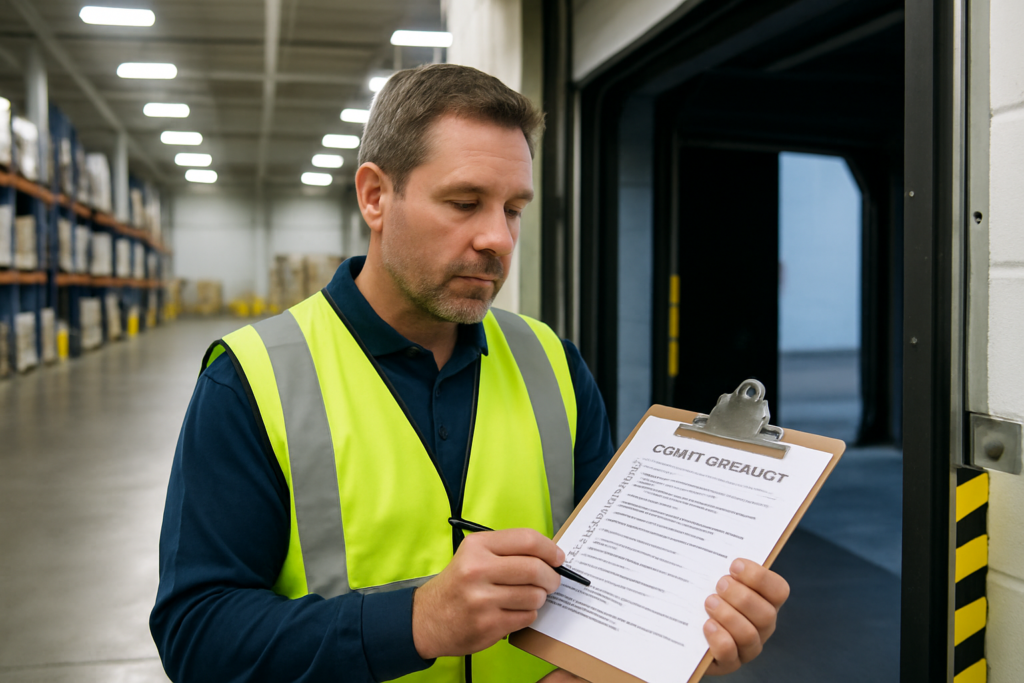
U.S. warehouses logged an injury rate of 4.8 per 100 full-time employees in 2024. This figure is more than double the 2.3 all-industry average, according to Voxel AI. A structured warehouse safety checklist provides one of the most practical tools available for closing that gap. It gives supervisors a repeatable framework to catch hazards before they become incidents.
Table of Contents
- Why Warehouse Safety Numbers Demand Attention
- Core Zones Every Warehouse Safety Checklist Must Cover
- Forklift and Material Handling Safety
- Ergonomics and Musculoskeletal Risk
- Technology’s Role in Modern Safety Programs
- Things to Know
Key Takeaways
- U.S. warehouses experience injuries at more than twice the national average across all industries.
- Loading docks and forklift operations are the two highest-risk zones and require dedicated checklist sections.
- Musculoskeletal disorder (MSD) injuries alone resulted in 18.5 million lost workdays in 2024.
- A checklist is most effective when workers complete it on a set schedule and tie it to corrective action tracking.
- Automation and computer vision tools are now measurably reducing injury rates for facilities that deploy them.
- OSHA compliance starts with documentation, and a completed checklist is auditable evidence.
Why Warehouse Safety Numbers Demand Attention
The transportation and warehousing sector recorded 232,000 injury cases in 2024, according to Voxel AI. That figure represents real people, real lost wages, and real liability exposure for operators. In New York State specifically, warehouse worker injuries increased 30% from 2022 to 2023. The rate reached 11.5 per 100 full-time workers, per ALIGN. For any facility operating in or around the NYC metro area, those numbers carry direct operational weight.
Additionally, a 2025 industry survey found that safety ranks as the top concern for 84% of warehouse respondents, according to Voxel AI. That level of concern reflects both regulatory pressure and the genuine cost of incidents. Incidents include workers’ compensation claims, productivity losses, and potential OSHA citations. A formal checklist does not replace a full safety management program. However, it creates the visible, repeatable structure that serious programs are built on.
Moreover, proper warehouse layout design principles play a foundational role in safety management. Your floor organization directly affects traffic flow, visibility, and the likelihood of collisions or falls.

Core Zones Every Warehouse Safety Checklist Must Cover
A reliable warehouse safety checklist organizes inspections by zone rather than by category. Here is a breakdown of the areas that demand consistent attention:
| Zone | Primary Hazards | Inspection Frequency |
|---|---|---|
| Loading Docks | Falls, struck-by, trailer creep | Daily (each shift) |
| Racking and Storage | Collapse, falling objects, overload | Weekly |
| Pedestrian Aisles | Forklift conflicts, slip/trip | Daily |
| Emergency Exits | Blocked exits, broken signage | Daily |
| Electrical Panels | Unauthorized access, overload | Monthly |
| Break Rooms / Offices | Fire hazards, poor housekeeping | Weekly |
Loading docks deserve particular scrutiny. According to Voxel AI, 25% of all warehouse accidents occur at loading docks. This makes them the single highest-risk zone in most facilities.
Your checklist should confirm that dock plates are secure. Wheel chocks must be in place, and dock doors should be properly aligned before any trailer loading or unloading occurs.
For storage areas, understanding the types of warehouse racking systems in use matters significantly. Each system carries distinct load limits and inspection points. Selective pallet rack, drive-in rack, and push-back systems each have different failure modes that a one-size-fits-all checklist may miss.
Forklift and Material Handling Safety
Between 35,000 and 62,000 forklift injuries occur annually in the United States, according to Voxel AI. Powered industrial trucks are involved in a disproportionate share of serious and fatal warehouse incidents. Therefore, OSHA’s 29 CFR 1910.178 mandates pre-shift inspections for every forklift before use.
A solid forklift section of your warehouse safety checklist should confirm:
- Operator certification is current and on file.
- Workers complete and sign off on pre-shift inspections.
- Horn, lights, and backup alarm are functional.
- Forks show no visible cracks or bends.
- Aisle width meets the minimum clearance for the equipment in use.
- Workers clearly mark and respect pedestrian crossing zones.
When you are thinking about how operational model affects safety, understanding what is cross docking in warehousing matters. High-velocity throughput operations create unique forklift traffic patterns that standard checklists may not anticipate.

Ergonomics and Musculoskeletal Risk
MSD injuries resulted in 18.5 million lost days of work in 2024, according to Voxel AI. Despite being less dramatic than forklift incidents or falls, ergonomic injuries are the leading driver of lost workdays across the industry. They represent a major cost center for any high-volume operation.
Your warehouse safety checklist items for ergonomic risk should include:
- Confirm that lift-assist equipment (pallet jacks, lift tables) is available and accessible to workers.
- Verify that teams store heavy items at waist height where possible, not at floor level or above shoulder height.
- Check that workers rotate tasks regularly to reduce repetitive-motion exposure.
- Confirm that anti-fatigue mats are present at stationary workstations.
- Review any recent near-misses or complaints related to strain or overexertion.
For facilities considering third-party logistics support to reduce in-house strain, knowing how to choose a 3pl provider with a strong documented safety record is a relevant part of due diligence.
Technology’s Role in Modern Safety Programs
The warehouse automation market reached $21.7 billion in 2024. It is projected to expand to $90.7 billion by 2034 at a 15.1% CAGR, according to Voxel AI. A growing portion of that investment is directed at safety-specific technology.
Computer vision platforms, wearable sensors, and cloud-based inspection apps are now standard tools at larger distribution centers. Moreover, organizations deploying computer vision technology have reported up to 77% injury reduction. They have also achieved complete elimination of OSHA citations within 12 months, according to Voxel AI. The safety observation software market alone was valued at $476 million in 2025. It is projected to reach $1.236 billion by 2034.
For smaller and mid-size operations, even a simple digital checklist completed on a tablet creates value. Store it in a cloud-based WMS to create the audit trail that paper logs cannot reliably provide.
Things to Know
- OSHA does not mandate a specific checklist format, but it does require documented evidence of hazard identification and correction.
- A checklist completed but not acted upon creates legal exposure. You must log every identified hazard in a corrective action log.
- New York State has additional warehouse-specific safety regulations that go beyond federal OSHA minimums. Local operators should consult the New York State Department of Labor guidelines.
- Frequency matters: conduct daily inspections for high-traffic zones, weekly for storage and racking, and monthly for utilities and emergency systems.
- Involving frontline workers in checklist development increases buy-in and often surfaces hazards that management does not see.
Protect Your Facility with a Free Warehousing Assessment
Warehousing NYC By Best operates across the NYC metro and tri-state area. We provide 3PL services that include documented safety protocols embedded in our day-to-day operations. Whether you need trusted bulk warehousing with compliant pallet racking or a fulfillment partner with a verifiable safety track record, we are ready to walk you through what we do and how we do it.
Request a free estimate today and speak directly with our team about how our safety-first warehouse operations can support your supply chain. Tell us your volume, your product type, and your timeline, and we will respond with a tailored proposal.
Frequently Asked Questions
Q: How often should a warehouse safety checklist be completed?
High-risk zones like loading docks and pedestrian aisles require inspection every shift. Racking and storage areas warrant weekly reviews.
Additionally, monthly inspections cover utilities, electrical panels, and emergency equipment. The frequency should reflect the actual hazard level of each zone, not a one-size-fits-all schedule.
Q: Is a warehouse safety checklist required by OSHA?
OSHA does not mandate a specific checklist format. However, it does require employers to maintain a safe workplace and document hazard identification and corrective actions.
In practice, a completed checklist serves as auditable proof that inspections occurred. During an OSHA inspection, that documentation can significantly influence the outcome of any citation review.
Q: What are the most common items missed on warehouse safety checklists?
Racking damage, blocked emergency exits, and expired fire extinguisher inspections are consistently among the most overlooked items.
Many facilities focus heavily on forklift and dock safety. Meanwhile, they underinspect overhead storage, exit pathways, and first-aid station readiness.
Q: Can a digital checklist replace a paper one?
Yes, and in most cases a digital checklist is more reliable because it creates a timestamped, searchable record that is harder to lose or alter.
Cloud-based tools also allow supervisors to assign corrective actions in real time and track completion. Paper logs cannot do this efficiently.
Q: How does a safety checklist reduce workers’ compensation costs?
By identifying hazards before incidents occur, a checklist directly reduces the frequency of claims. Over time, this lowers experience modification rates and insurance premiums.
Facilities with documented, consistent inspection programs often qualify for lower workers’ compensation rates. They also face reduced OSHA penalty exposure in the event of an incident.
The Bottom Line on Warehouse Safety Checklists
A warehouse safety checklist is not a bureaucratic formality. It is a practical, repeatable system for protecting workers, maintaining OSHA compliance, and reducing the financial cost of preventable incidents. With New York State injury rates running well above national averages, facilities in this region have both the most to gain and the least room to be complacent.
Start by mapping your highest-risk zones. Assign inspection ownership to named team members. Build a corrective action log alongside your warehouse safety checklist. If you need operational support from a 3PL partner with documented safety standards already in place, reach out to the Warehousing NYC By Best team today.