

Warehouse inventory management software is a digital platform that tracks stock levels, locations, and movements across a facility in real time. It replaces manual processes with automated workflows that reduce errors, speed up fulfillment, and give operations teams a single source of truth for every SKU they handle. Moreover, this type of software has become essential for businesses that want to maintain accurate inventory without relying on spreadsheets and manual counting.
Key Takeaways
- Warehouse inventory management software automates stock tracking, order fulfillment, and reporting across your entire operation.
- Real-time visibility is the core value proposition: teams know exactly what is in stock, where it is, and when it needs to be replenished.
- Integration with ERPs, eCommerce platforms, and carrier systems is what separates capable systems from basic spreadsheet replacements.
- Choosing the right software depends on your order volume, SKU complexity, and whether you operate in-house or through a 3PL partner.
- RFID, barcode scanning, and cloud-based WMS technology now make accurate inventory tracking accessible at multiple price points.
- Businesses that outgrow their current system often see the clearest return on investment when they switch to a modern platform.
Table of Contents
- Why Inventory Visibility Is a Warehouse’s Most Critical Asset
- Core Features That Define Warehouse Inventory Management Software
- How WMS Technology Has Evolved
- Comparing Deployment Options for Warehouse Inventory Management Software
- What to Evaluate Before Committing
- Things to Know
- How Warehousing NYC By Best Puts This Into Practice
Why Inventory Visibility Is a Warehouse’s Most Critical Asset
Poor inventory visibility is one of the most preventable causes of fulfillment breakdowns. When stock data is unreliable, teams either overstock to compensate or run out of fast-moving items at the worst possible time. Both outcomes create real costs: carrying costs on idle inventory, expedited shipping fees to cover shortfalls, and customer churn when orders arrive late or incomplete.
Warehouse inventory management software solves this problem by creating a continuous digital record. Every item enters, moves through, and leaves a facility with full documentation. Receiving teams scan inbound shipments. Pick teams confirm each pull. Outbound orders receive verification before shipping. Additionally, nothing relies on memory or a manually updated spreadsheet.
Understanding how modern warehousing uses technology to track and protect inventory makes it clearer why software has become the operational backbone of any serious fulfillment operation, not just a nice-to-have upgrade.

Core Features That Define Warehouse Inventory Management Software
Not all warehouse management systems offer the same capabilities. The features that matter most depend on your operation’s complexity. However, a few core abilities separate useful platforms from ones that create more problems than they solve.
Real-time inventory tracking is non-negotiable. The system must update stock counts as transactions happen, not at the end of a shift or after a manual sync.
Receiving and putaway workflows guide incoming goods to the right bin location. They create an auditable record from the moment freight arrives at your facility.
Pick, pack, and ship support is where warehouse inventory management software pays for itself most visibly. Directed picking routes reduce walk time. Scan-to-verify steps catch mis-picks before they ship. In addition, if you are unfamiliar with how this process works at a fundamental level, reviewing what is pick pack and ship is a useful starting point before evaluating any platform.
Cycle counting tools allow teams to audit inventory in sections rather than shutting down operations for a full physical count. This approach keeps data accurate without disrupting throughput.
Reporting and analytics tie everything together. The best systems surface demand trends, aging inventory, and fulfillment accuracy rates. Therefore, managers can make decisions based on data rather than instinct.
| Feature | Basic WMS | Mid-Tier WMS | Enterprise WMS |
|---|---|---|---|
| Real-time stock tracking | Yes | Yes | Yes |
| Multi-location support | Limited | Yes | Yes |
| RFID integration | No | Optional | Yes |
| ERP/eCommerce integration | Manual | API-based | Native + custom |
| Cycle counting | Manual | Guided | Automated scheduling |
| Reporting depth | Basic | Configurable | Advanced analytics |
| Typical cost tier | $ | $$ | $$$ |
How WMS Technology Has Evolved
Early warehouse management systems were on-premise solutions. They were expensive to install, hard to update, and dependent on internal IT teams. Cloud-based platforms have largely replaced that model for small and mid-sized operations. Today’s systems run in a browser, update automatically, and integrate with eCommerce platforms, carrier APIs, and ERPs without requiring a dedicated developer on staff.
Hardware has evolved in parallel with software capabilities. Before investing in RFID infrastructure, it is worth reviewing the pros and cons of using RFID for inventory management to understand where the technology genuinely adds value. In some cases, RFID adds cost without proportional benefit. Barcode scanning remains the most common method for tracking individual items. However, RFID has grown in adoption across industries that handle high-volume or high-value goods.
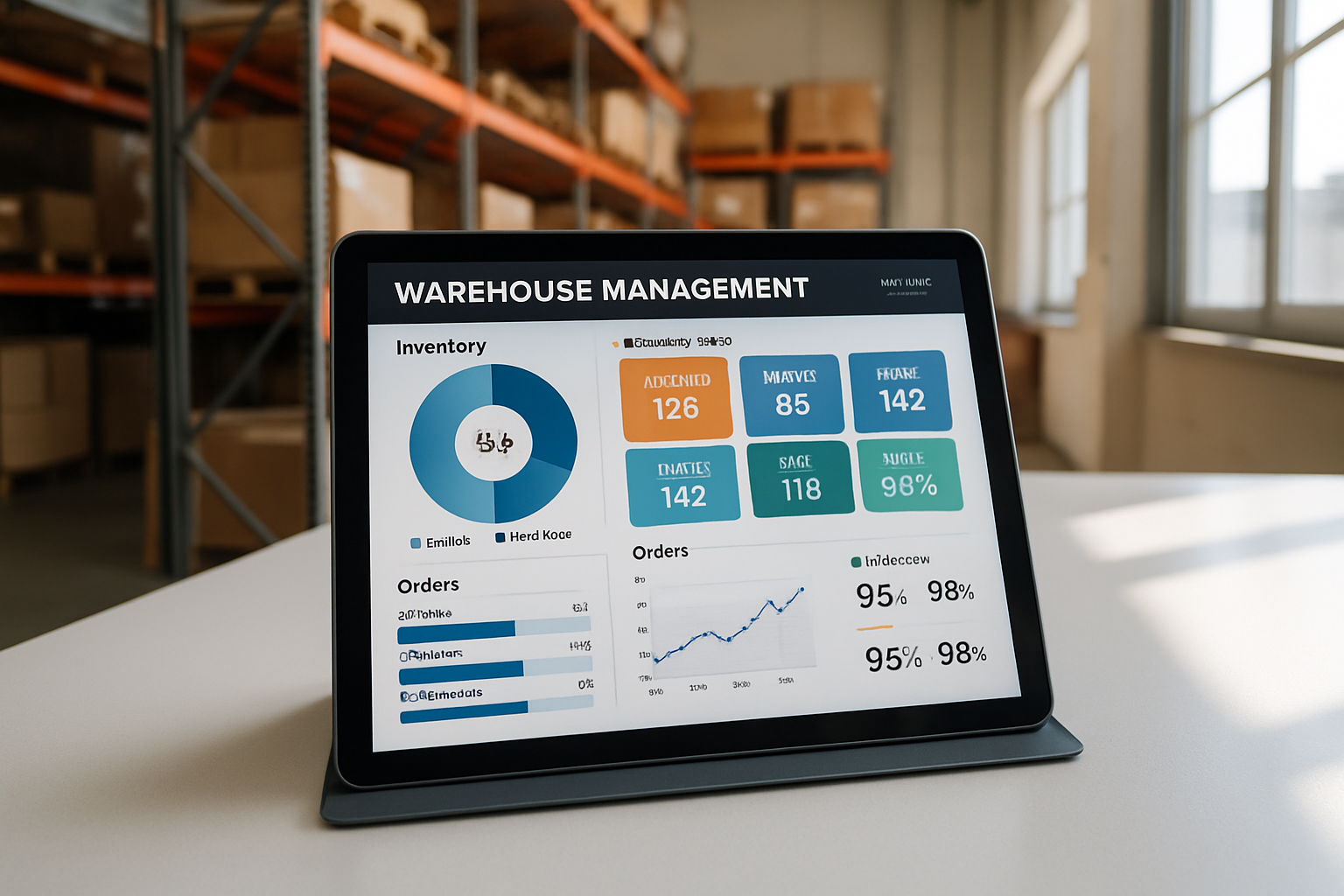
Mobile-first design is now standard in modern warehouse inventory management software platforms. Warehouse staff use handheld devices or wrist-worn scanners that connect to the WMS in real time. As a result, floor-level data is always current and managers can monitor operations from any device.
Comparing Deployment Options for Warehouse Inventory Management Software
The choice between cloud-based and on-premise deployment affects more than technology. It impacts cost structure, update frequency, and how easily the system scales.
Cloud-based WMS platforms typically charge a monthly subscription fee. Updates push automatically, and most vendors handle data security and backups. This model suits growing businesses that need flexibility without a large upfront capital commitment.
On-premise WMS solutions require a server infrastructure investment and an internal team to manage updates and maintenance. They offer greater control over customization. However, they come with higher initial costs and slower iteration cycles.
3PL-managed WMS access is a third option worth considering, especially for businesses that need to coordinate shipping warehousing companies across multiple nodes. Cloud-based systems with API connectivity are the most practical choice for keeping data consistent across locations. When a business partners with a third-party logistics provider, they often gain access to the provider’s existing WMS as part of the service agreement. This removes the burden of software selection, implementation, and maintenance entirely. Furthermore, clients still receive real-time visibility into their inventory.
What to Evaluate Before Committing
Selecting warehouse inventory management software is a significant operational decision. Rushing into a platform because it has a polished demo is a common and costly mistake. Before signing any agreement, evaluate the following criteria:
- Integration depth: Does the system connect natively with your eCommerce platform, ERP, and carrier accounts, or will you need custom middleware?
- Scalability: Can the system handle peak season volume without performance degradation?
- Onboarding and training: What does implementation actually look like? Who is responsible for data migration from your current system?
- Support quality: Is live support included, or do you pay extra for faster response times?
- Total cost of ownership: Factor in subscription fees, implementation costs, hardware requirements, and any per-transaction fees.
Things to Know
- Many platforms advertise “real-time” tracking but only update inventory at batch intervals. Confirm the update frequency before purchasing.
- A WMS is only as accurate as the receiving process that feeds it. Software cannot compensate for inconsistent inbound scanning habits.
- Integration with eCommerce platforms like Shopify, Amazon, and WooCommerce is increasingly standard. However, the depth of that integration varies widely between vendors.
- Free trials often use simplified demo data. Ask to pilot the system with your actual SKU catalog and order volume before committing.
- Regulatory industries such as food, pharma, and medical devices may require WMS features like lot tracking, expiration date management, and FDA-compliant audit trails.
How Warehousing NYC By Best Puts This Into Practice
Warehousing NYC By Best operates as a full-service 3PL provider serving the NYC metro and tri-state area. Their technology stack includes a cloud-based WMS with real-time inventory tracking, cycle count tools, and direct integrations with Shopify, Amazon, WooCommerce, and ERP systems. An in-house development team manages these integrations. Clients get live inventory visibility without purchasing or maintaining their own platform.
Their services span trusted and bulk warehousing, pick/pack/kitting, eCommerce and retail fulfillment, cold chain logistics, and LTL/FTL transportation. For businesses that need a scalable fulfillment operation without the overhead of managing software, hardware, and warehouse staff independently, Warehousing NYC By Best provides the infrastructure and technology under one roof.
Take Control of Your Inventory: Talk to Warehousing NYC By Best
If your current system is costing you time, accuracy, or customer trust, it is time to look at what a modern fulfillment partner can provide. Warehousing NYC By Best gives clients real-time inventory visibility, seamless eCommerce integrations, and a scalable 3PL operation built for the demands of the NYC market.
Get your free quote today and find out how we can simplify your inventory operations from day one. Reach out through our contact page to speak with a member of our team about your specific volume, SKU mix, and fulfillment requirements.
Frequently Asked Questions
Q: What is the difference between a WMS and inventory management software?
A WMS (warehouse management system) manages physical warehouse operations. In contrast, inventory management software focuses primarily on stock levels and replenishment.
A WMS typically includes directed putaway, pick routing, labor tracking, and shipping integrations. Inventory management software is often lighter and suited to businesses that store goods off-site or have simpler fulfillment needs. Moreover, many modern platforms blur the line between the two categories.
Q: How much does warehouse inventory management software cost?
Costs range from a few hundred dollars per month for basic cloud platforms to tens of thousands of dollars for enterprise on-premise deployments.
Pricing depends on the number of users, integrations required, transaction volume, and whether implementation and training are included. Additionally, small businesses often find cloud-based subscriptions more manageable financially. Large operations may justify higher upfront costs for greater customization.
Q: Can small businesses benefit from a WMS?
Yes. Cloud-based WMS platforms have made professional inventory management accessible to businesses with relatively low order volumes.
Even small eCommerce sellers benefit from automated order routing, accurate stock counts, and integration with sales channels. Therefore, the key is choosing a platform scaled to your current needs with room to grow.
Q: How long does it take to implement warehouse inventory management software?
Implementation timelines vary from a few days for basic SaaS platforms to several months for complex enterprise deployments.
The biggest variable is data migration. Moving SKU catalogs, historical order data, and supplier records from a legacy system takes considerable time. Working with a provider that has an in-house development team, as Warehousing NYC By Best does, can shorten this process significantly.
Q: What integrations should warehouse inventory management software support?
At minimum, your WMS should connect to your eCommerce platform, ERP system, and carrier accounts.
Common integrations include Shopify, WooCommerce, Amazon Seller Central, QuickBooks, and major parcel carriers like UPS and FedEx. Deeper integrations, such as real-time API syncing rather than manual CSV imports, reduce errors and eliminate duplicate data entry.
The Bottom Line on Warehouse Inventory Management Software
The right warehouse inventory management software does more than count stock. It connects every touchpoint in your operation, from receiving to shipping, into a single system that reduces errors and supports growth. Whether you are evaluating standalone platforms or considering a 3PL partner that provides managed WMS access, the priority is the same: real-time accuracy, reliable integrations, and a system your team will actually use.
Start by auditing where your current process breaks down most often. Use that analysis as your evaluation criteria. The right platform addresses your actual pain points, not just the features that look impressive in a demo.