
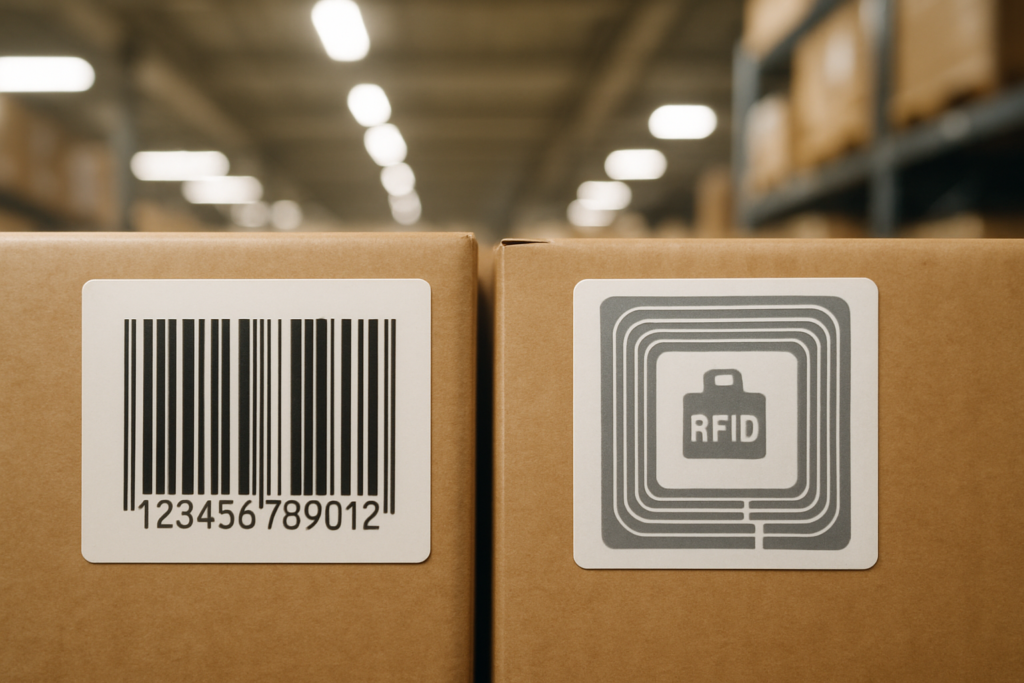
When choosing between RFID vs barcode inventory tracking systems, you’ll find important trade-offs to evaluate. RFID delivers significantly higher accuracy and speed, while barcodes remain the more affordable and widely deployed option. The right choice depends on your operation’s volume, budget, and long-term scalability goals.
Table of Contents
- How RFID and Barcode Technology Works
- RFID vs Barcode: Accuracy and Speed Metrics
- RFID vs Barcode Cost Comparison: Upfront Investment vs Long-Term ROI
- Where RFID vs Barcode Systems Perform Best
- Integration With Warehouse Technology
- RFID vs Barcode Adoption Trends Across U.S. Retail and Logistics
How RFID and Barcode Technology Works
Barcodes use a printed pattern of parallel lines that a handheld or fixed scanner reads using a laser or camera. Each item must be individually positioned within the scanner’s line of sight. The scanner captures a single identifier at a time. This one-at-a-time process has been the industry standard since the 1970s. It remains reliable precisely because of its simplicity.
RFID (Radio Frequency Identification) works differently. Each item carries a small tag containing a microchip and antenna. A reader emits a radio signal. Any tag within range responds by transmitting its stored data. No particular positioning direction is needed. A single RFID reader can scan hundreds of items simultaneously. It reads through packaging, around corners, or across an entire pallet.
There are two primary RFID categories relevant to warehousing:
- Passive RFID: Tags have no internal power source and are activated by the reader’s signal. Lower cost per tag, shorter read range (typically under 20 feet). These dominate retail and logistics applications.
- Active RFID: Tags carry their own battery and continuously broadcast their signal. Higher cost, longer range, used for high-value asset tracking or cold chain applications.
Ultra-high frequency (UHF) passive RFID has become the standard for warehouse and retail use. It balances read speed, range, and tag cost effectively. According to Business Research Insights (2024), about 19% of new retail RFID deployments in 2024 adopted UHF systems. They chose these systems specifically for faster data reading. This figure reflects growing momentum toward high-throughput scanning environments.

RFID vs Barcode: Accuracy and Speed Metrics
This is where the performance gap between the two technologies becomes most significant.
According to a McKinsey Retail Operations Study, RFID systems achieve 99% accuracy in inventory tracking. Barcode systems achieve 85% accuracy. That 14-percentage-point gap has real operational consequences. In a warehouse processing 50,000 SKUs, an 85% accuracy rate means roughly 7,500 items with location or count errors at any given time. This creates downstream problems in order fulfillment, replenishment, and customer satisfaction.
The speed difference is equally striking. According to CPCON (January 2025), RFID typically delivers 3 to 5 times faster inventory processing speeds. It achieves 99.9%+ accuracy compared to barcode systems. Most warehouse operations processing 10,000 or more items daily achieve ROI in 12 to 24 months.
In practical terms, data from Fulfil Blog (2026) shows that RFID reduces inventory counting time by 90 to 95%. A process that takes 8 hours manually typically takes only 30 to 45 minutes with RFID. For distribution centers running tight fulfillment windows, this fundamental improvement changes how frequently you can perform cycle counts. You’ll identify shrinkage faster. You’ll meet same-day or next-day shipping commitments more reliably through better warehouse inventory management software.
Barcode accuracy issues often stem from human error. Missed scans, mislabeled items, or damaged labels that scanners cannot read are common problems. RFID eliminates most of these failure points. No line-of-sight or manual positioning is required.
RFID vs Barcode Cost Comparison: Upfront Investment vs Long-Term ROI
Cost is the primary reason barcode systems still dominate in many operations. According to Altavant Consulting (2025), over 70% of global warehouses still rely on barcode scanning. Cost remains the central barrier to RFID adoption.
Here is a straightforward breakdown of where costs differ:
| Cost Factor | Barcode | RFID |
|---|---|---|
| Labels per unit | $0.01 to $0.05 | $0.10 to $1.50+ (passive tags) |
| Reader hardware | $200 to $1,000 | $1,000 to $5,000+ per reader |
| Software integration | Low to moderate | Moderate to high |
| Ongoing maintenance | Minimal | Firmware updates, reader calibration |
| Labor savings over time | Minimal | Significant |
| Implementation complexity | Low | High |
Nearly 37% of small and mid-sized retailers face challenges due to high initial installation and integration costs when adopting RFID. This figure comes from Business Research Insights (2024). For a business with thin margins or low SKU volume, barcode systems offer a credible and cost-effective path that should not be dismissed.
However, for operations processing 10,000 or more items daily, the math shifts quickly. Understanding the distinction between a fulfillment center vs warehouse helps clarify whether your operation’s volume justifies RFID investment. Labor savings from automated bulk scanning are significant. Reduced shrinkage and fewer fulfillment errors tend to produce ROI within 12 to 24 months at that scale. This comes from CPCON (January 2025). The key is matching the technology to your operational volume. You should not treat RFID as universally superior.
Where RFID vs Barcode Systems Perform Best
Not every warehouse environment benefits equally from RFID or barcodes. Operational context matters considerably.
Barcode systems are well-suited for:
- Small to mid-sized warehouses with limited SKU counts
- Operations where items are handled individually at pick stations
- Businesses with tight capital budgets and no immediate plans to scale significantly
- Environments where items are made of metal or liquid-containing packaging (which can interfere with RFID signals)
RFID systems are well-suited for:
- High-volume distribution and fulfillment centers processing thousands of items per shift
- Apparel, electronics, and pharmaceutical sectors where per-item visibility is critical
- Operations running real-time inventory visibility across multiple locations
- Businesses where shrinkage, misplacement, or stockouts carry significant revenue consequences
The National Retail Federation has reported that RFID systems have helped cut stock discrepancies by nearly 25 million items annually. This figure reflects the technology’s value at scale in retail supply chains.
Understanding whether your facility functions as a bulk storage location or an active fulfillment hub is central to this decision. Our breakdown of fulfillment center vs warehouse explains the operational differences in detail. It can help frame where each tracking technology fits within your business model.
Integration With Warehouse Technology
The value of either tracking system depends heavily on how well it connects to the rest of your operational stack.
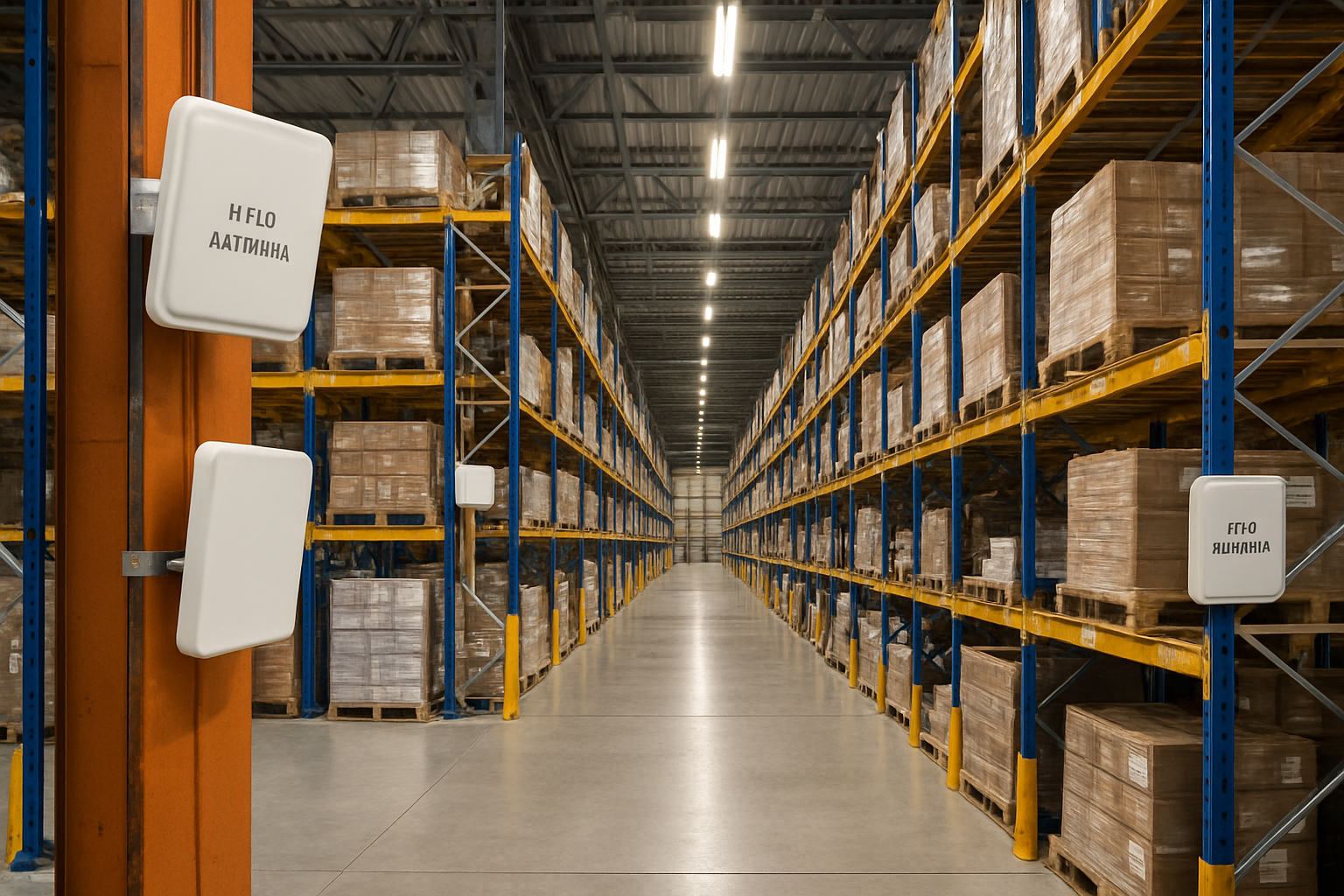
Barcode systems integrate easily with most legacy warehouse management platforms. They require minimal custom development. RFID integration is more complex. Tags generate substantially higher data volumes. Your WMS must be configured to ingest, deduplicate, and act on that real-time data stream. You must do this without creating bottlenecks.
For businesses evaluating technology upgrades, choosing the right warehouse inventory management software is a foundational step. Do this before committing to either tracking method at scale. A WMS that supports both barcode and RFID inputs gives operations the flexibility to start with barcodes. You can migrate incrementally as volume justifies the investment.
At Warehousing NYC By Best, our cloud-based WMS and in-house development team support ERP and marketplace integrations. We work across Shopify, Amazon, and WooCommerce platforms. This means clients transitioning between tracking systems, or running hybrid environments, do not have to rebuild their operational infrastructure from scratch.
Transportation logistics also intersect with inventory tracking decisions. Shipments routed through multiple handoff points require accurate item-level data at each stage. Carriers and 3PL providers operating under truck driver hours of service rules face tight windows for loading and unloading. In these high-frequency LTL and FTL environments, faster RFID scanning at dock doors can reduce turnaround time significantly.
RFID vs Barcode Adoption Trends Across U.S. Retail and Logistics
The market trajectory for RFID is clear and accelerating. According to Grand View Research (2025), the global RFID technology market was estimated at $20.10 billion in 2024. It is projected to reach $47.63 billion by 2030. This represents a CAGR of 15.8% from 2025 to 2030. Precedence Research (2025) offers a comparable projection. They estimate the global RFID market at $17.73 billion in 2025. They anticipate growth to approximately $48.51 billion by 2034.
Adoption in the U.S. retail sector is already advanced. According to an Accenture Report (2024), 93% of North American retailers are using RFID technology in some capacity as of late 2024. This does not mean full warehouse deployment in every case. Many are using RFID selectively at checkout, in fitting rooms, or for loss prevention. However, it signals that RFID is no longer a niche or emerging technology in this market.
On the manufacturing side, 28% of North American manufacturers identified inefficient inventory management as a major supply chain challenge in the past year. This comes from the Parsec 2024 State of Manufacturing Survey. For that segment, the conversation around RFID vs barcode inventory tracking is often tied directly to reducing carrying costs. They also focus on improving throughput visibility.
Retailers that have made the switch are reporting measurable results. Additionally, around 64% of retailers reported improved inventory accuracy and reduced stockouts after adopting RFID technology. This figure comes from Business Research Insights (2024). The benefit becomes even more critical when evaluating the amazon fba vs 3pl fulfillment decision. Brands scaling through multiple channels need inventory visibility that barcode-only systems can struggle to provide at speed and accuracy.
For 3PL providers like Warehousing NYC By Best, supporting clients across both technologies is a practical necessity. Some clients arrive with barcode-based systems already embedded in their supplier relationships. Others are scaling rapidly. They need RFID-ready infrastructure from day one. The ability to handle both technologies, and to advise on when the transition from one to the other makes financial sense, is part of what separates capable 3PL partners from those offering one-size-fits-all solutions.
The decision is not simply technical. It involves evaluating your order volume, your error tolerance, your labor costs, and your integration requirements together. Businesses that approach it that way tend to make investments they do not have to reverse within two years.
Things to Know
- RFID tags can be disrupted by metal surfaces and liquid-filled containers, which interfere with radio frequency signals. If your inventory includes these materials, passive UHF RFID may require specialized tags or adjusted reader placement to maintain accuracy.
- Barcodes require line-of-sight scanning, meaning a damaged, smudged, or poorly printed label will result in a missed scan. In high-humidity environments like cold storage facilities, label degradation is a real operational concern.
- Hybrid deployments are common and practical. Many U.S. warehouses use barcodes for standard SKU tracking and RFID selectively for high-value items, pallets, or dock door verification. You do not have to choose one system exclusively.
- RFID tag costs vary significantly by application. Standard passive UHF labels for retail apparel can cost as little as $0.10. Ruggedized tags for reusable assets or cold chain use can reach $1.50 or more per unit. Volume pricing from suppliers can substantially reduce per-tag costs at scale.
- Transitioning from barcodes to RFID mid-operation requires careful change management. Staff retraining, WMS reconfiguration, and supplier label compliance all need to be addressed before go-live. Do this to avoid inventory gaps during the switchover.
- Data privacy and security are growing considerations with RFID. Because tags can be read without direct contact or visibility, unintended reads and data interception are possible in environments without proper reader shielding or access controls.
Start Tracking Inventory With the Accuracy Your Operation Demands
If your current system is creating stockouts, slowing down fulfillment, or forcing your team to spend full days on manual counts, the cost of staying where you are is already measurable. Warehousing NYC By Best provides 3PL warehousing, order fulfillment, and real-time inventory tracking for businesses operating in and shipping to the NYC metro and tri-state area. We build infrastructure to support both barcode and RFID-ready environments.
Request a free estimate to find out how our cloud-based WMS and fulfillment infrastructure can support your tracking technology requirements from day one.
Tell us your current order volume, SKU count, and tracking setup, and we will give you a straightforward assessment of what fits your operation.
Frequently Asked Questions
Q: Is RFID worth the cost for a small warehouse or small business?
For most small warehouses processing fewer than 10,000 items daily, barcodes remain the more cost-effective choice.
RFID hardware, tag costs, and integration expenses are difficult to justify at low volumes. The ROI window of 12 to 24 months cited for RFID applies specifically to higher-volume operations. Small businesses should evaluate barcode systems first. Then revisit RFID as order volume and SKU complexity grow.
Q: Can RFID and barcode systems run simultaneously in the same warehouse?
Yes, hybrid RFID and barcode deployments are widely used in U.S. warehouses and are fully supported by most modern WMS platforms.
Many operations use barcodes for standard carton or SKU-level tracking and RFID for pallet-level verification, dock door receiving, or high-value asset monitoring. Running both systems in parallel does require a WMS capable of ingesting data from multiple input types. Therefore, confirming software compatibility before investing in hardware is essential.
Q: How much does it cost to implement an RFID system in a mid-sized U.S. warehouse?
Total implementation costs for a mid-sized warehouse typically range from tens of thousands to several hundred thousand dollars, depending on reader quantity, tag volume, and integration complexity.
Fixed RFID readers for dock doors and aisle entry points represent a significant upfront hardware cost. Additionally, integrating RFID data streams into an existing WMS or ERP often requires custom development work. Nearly 37% of small and mid-sized retailers cite high initial installation and integration costs as the primary adoption barrier. This comes from Business Research Insights (2024). Getting itemized quotes from at least two or three vendors before committing is a sound practice.
Q: What industries in the United States are seeing the fastest RFID adoption?
Retail apparel, pharmaceuticals, electronics, and third-party logistics are the U.S. industries with the highest current rates of RFID adoption.
Retail has led adoption for years. In fact, 93% of North American retailers are using RFID in some capacity as of late 2024. This comes from an Accenture Report (2024). Pharmaceuticals have been pushed toward item-level tracking by federal drug supply chain security requirements. Moreover, the 3PL and logistics sector is accelerating adoption. Clients demand real-time, multi-location inventory visibility that barcode systems cannot efficiently provide at scale.
Q: Does RFID work well in cold storage or temperature-controlled warehouse environments?
RFID can function effectively in cold storage environments, but it requires tags and readers specifically rated for low-temperature operation.
Standard passive RFID tags are generally rated for temperatures down to approximately -4°F. This covers most commercial refrigerated storage. However, frozen storage environments that drop below that threshold require specialized cryogenic tags. These carry higher per-unit costs. Reader placement also needs to account for condensation on antennas and surfaces. Condensation can affect signal consistency. Working with a vendor experienced in cold chain RFID deployments is advisable before committing to a specific hardware configuration.